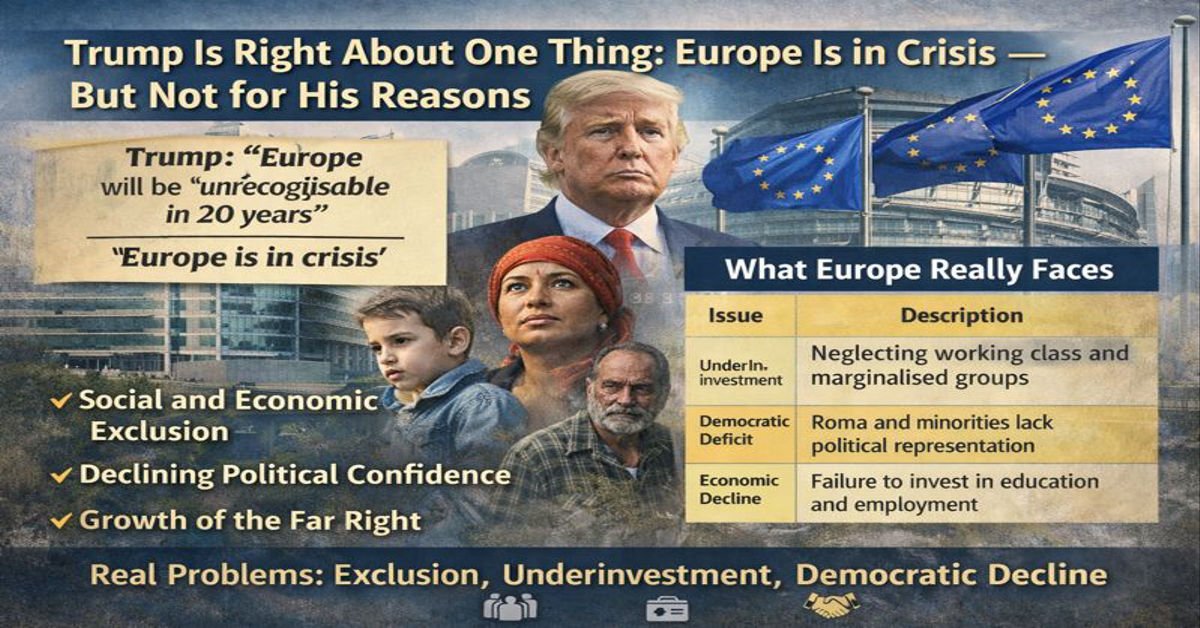
Europe’s real challenge is exclusion, underinvestment, and a growing democratic deficit, not “civilisational erasure” US President Donald Trump has spent years publicly criticising Europe, but his views took on new weight when they were formally embedded in America’s National Security Strategy (NSS). The document paints a stark picture, warning that Europe could become “unrecognisable in 20 years” unless the United States intervenes to restore its “former greatness”.
Trump is correct that Europe faces a serious crisis. However, the causes he identifies — immigration, cultural decline, and a loss of identity — miss the deeper and more damaging realities undermining the continent.
Europe’s crisis is not about civilisation. It is about systematic underinvestment in people, political exclusion, and an unwillingness to confront long-term social and economic decline.
Europe’s Crisis Is Structural, Not Cultural
Across much of Europe, political leaders avoid addressing uncomfortable truths. Entire communities have been left behind as industries collapsed, public services weakened, housing became unaffordable, and education systems stagnated.
While debates rage about identity and borders, the real issue is exclusion.
Millions of Europeans in working-class communities face declining living standards. Among them, the Roma — Europe’s largest and most marginalised minority — provide a clear lens through which the continent’s failures can be seen.
The Roma Experience Exposes Europe’s Weaknesses
With an estimated 12 million people, the Roma community represents Europe’s youngest and fastest-growing population. Yet they remain systematically excluded from education, employment, housing, and political representation.
Rather than addressing these failures, governments often respond with securitisation and scapegoating.
Examples of Discriminatory Policies Across Europe
| Country | Policy or Incident |
|---|---|
| Slovenia | Laws passed to securitise Roma neighbourhoods |
| Portugal | Far-right campaign posters targeting Roma |
| Italy | Political campaigns built on anti-Roma rhetoric |
| Greece | Police violence against Roma youth |
This pattern reveals a deeper contradiction: European leaders show caution toward external threats, such as Russia, while acting aggressively toward vulnerable communities at home.
What Trump Gets Right About Europe
The NSS argues that Europe lacks self-confidence, particularly in its approach to Russia. On this point, Trump is not entirely wrong.
A confident Europe would:
-
Defend democratic values consistently
-
Protect minorities instead of demonising them
-
Invest in social cohesion as a security strategy
Instead, Europe often compromises its own values internally while hesitating to defend them externally.
Economic Decline and a Wasted Workforce
Trump’s strategy also highlights Europe’s shrinking share of global GDP — a drop from 25 percent in 1990 to about 14 percent today. While regulation and demographics play a role, the deeper issue is Europe’s failure to fully use its human capital.
The Economic Cost of Exclusion
Roma unemployment rates in countries like Romania, Slovakia, and Bulgaria are around 25 percentage points higher than national averages.
If Roma employment matched national levels in just these three countries, the economic gains could be substantial.
| Indicator | Estimated Impact |
|---|---|
| Potential GDP gain | €10 billion |
| Annual workforce loss in Europe | ~2 million workers |
| Roma population | ~12 million |
Leaving such a large and willing workforce excluded is not just unjust — it is economically self-destructive.
Europe’s Democratic Deficit Is Real
The NSS warns of democratic erosion in Europe. While Trump frames this around free speech and far-right politics, the more pressing issue is representation.
Despite their population size, Roma communities have no dedicated representation in the European Parliament.
Representation Gap in Europe
| Group or State | Population | Parliamentary Seats |
|---|---|---|
| Malta | ~570,000 | Yes |
| Luxembourg | ~680,000 | Yes |
| Roma (Europe-wide) | ~12 million | None |
This exclusion weakens democracy, lowers voter participation, and increases vulnerability to political manipulation.
Why Trump’s Solution Would Make Things Worse
Trump appears to believe that empowering nationalist and far-right movements can reverse Europe’s decline. Evidence suggests the opposite.
Countries where xenophobia shapes policy have struggled economically and politically.
Lessons From Europe’s Recent Past
| Country | Outcome |
|---|---|
| United Kingdom | GDP estimated 6–8% lower after Brexit |
| Hungary | Stagnant growth, high deficits, frozen EU funds |
Exclusion weakens economies and erodes democratic institutions. Far-right governance does not restore strength — it deepens dependence on external powers.
What Europe Actually Needs
Europe cannot survive by clinging to nostalgia or relying on rhetorical commitments to liberal values. Nor can it afford a retreat into exclusionary nationalism.
What Europe needs is inclusive realism — the recognition that investing in all people is not charity, but strategy.
China’s rise demonstrates this clearly: sustained investment in education, health, and employment expanded human capital and reshaped global power dynamics.
Europe must make a similar choice.
A Defining Choice for Europe’s Future
The real choice facing Europe is not between liberals and the far right. It is between:
-
Continuing to sideline millions and deepen social fractures, or
-
Investing in people it has long treated as expendable
A continent that wastes its population cannot remain competitive. A democracy that excludes millions cannot claim legitimacy.
Europe’s crisis is real — but its recovery depends not on fear, but on inclusion, representation, and long-term investment in its people.
4 thoughts on “Europe crisis Trump analysis”