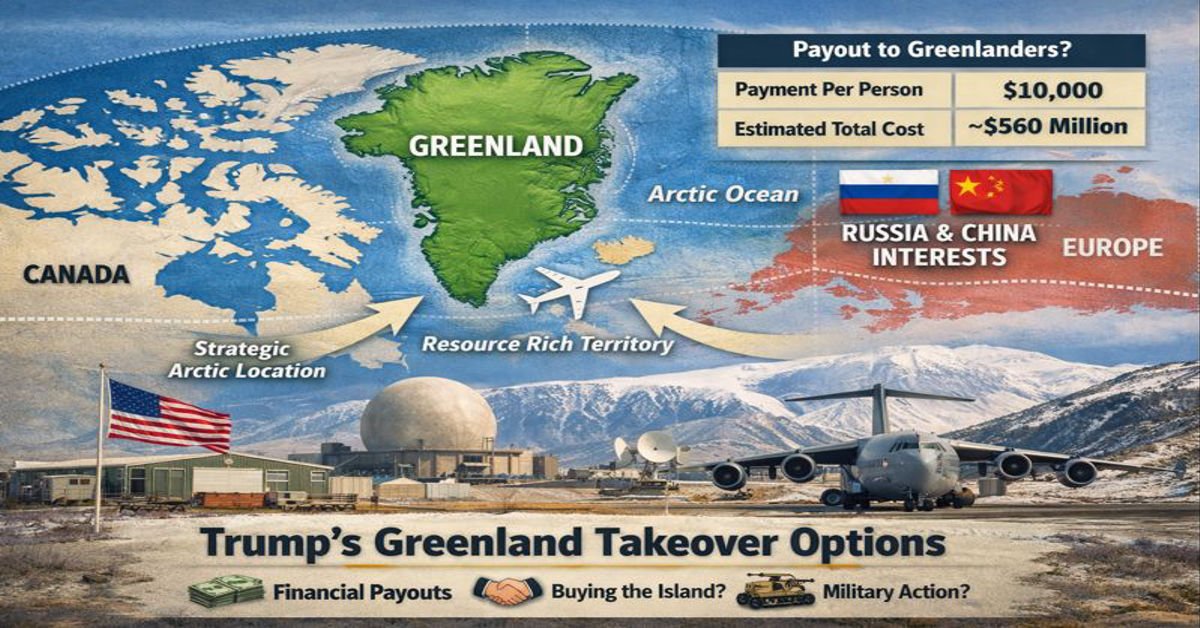
Exploring diplomatic pressure, financial incentives, and military realities behind Washington’s renewed interest in Greenland. Former US President Donald Trump’s renewed push to gain control over Greenland has triggered sharp reactions across Europe and raised serious questions about sovereignty, international law, and Arctic security. While Trump has framed his ambitions as a matter of national security, critics argue that his rhetoric crosses diplomatic red lines and risks destabilising relations with long-standing allies.
Since returning to the White House last year, Trump has repeatedly stated that the United States wants Greenland “very badly,” warning that Washington could pursue both “easy” and “hard” approaches if diplomacy fails. His comments have alarmed Greenlandic leaders, Denmark, and European Union officials, particularly after he suggested that military force remains an option.
This article examines the realistic paths the United States could pursue — from financial incentives to outright coercion — and why Greenland has become such a critical geopolitical flashpoint.
Why Greenland Matters to the United States
Greenland is the world’s largest island and sits almost entirely within the Arctic Circle. Despite its small population of roughly 56,000 people, its strategic importance far outweighs its size.
For Washington, Greenland represents:
-
A key military vantage point between North America and Europe
-
A critical Arctic surveillance location
-
Access to rare earth minerals and untapped natural resources
Trump has repeatedly argued that if the US does not act, rival powers such as Russia or China could expand their influence in the region.
Image Suggestion:
Image: Arctic shipping routes near Greenland with NATO and Russian zones marked.
Option One: Paying Greenlanders to Support Separation
One of the most controversial ideas reportedly discussed inside the White House involves direct payments to Greenland’s residents.
According to reports, US officials have floated the idea of offering between $10,000 and $100,000 per person to encourage Greenlanders to vote for independence from Denmark — a first step toward closer ties with Washington.
Greenland’s Political Status Explained
Greenland is an autonomous territory within the Kingdom of Denmark. While it controls most domestic affairs, Denmark retains authority over:
-
Foreign policy
-
Defence
-
Monetary matters
Since 2009, Greenland has held the legal right to declare independence following a successful referendum.
Estimated Cost of a Payout Strategy
| Scenario | Payment Per Person | Estimated Total Cost |
|---|---|---|
| Low estimate | $10,000 | ~$560 million |
| High estimate | $100,000 | ~$5.6 billion |
While such figures may appear manageable for the US federal budget, political analysts note that money alone is unlikely to change public opinion.
Can the United States Simply “Buy” Greenland?
Trump has previously described Greenland as “essentially a large real estate deal,” reviving a centuries-old concept of territorial purchases.
White House officials have confirmed that buying Greenland from Denmark has been discussed internally. However, both Nuuk and Copenhagen have firmly rejected the idea, stating repeatedly that Greenland is not for sale.
Historical Precedents for US Territorial Purchases
| Territory | Year | Seller | Price |
|---|---|---|---|
| Louisiana | 1803 | France | $15 million |
| Alaska | 1867 | Russia | $7.2 million |
| US Virgin Islands | 1917 | Denmark | $25 million |
Unlike previous cases, Denmark has shown no willingness to negotiate, making a legal purchase highly improbable.
Public Opinion: A Major Obstacle
Even if financial or diplomatic pathways were pursued, public resistance remains a major barrier.
-
85% of Greenlanders oppose becoming part of the United States
-
Only 7% of Americans support a US military takeover
Experts argue that bypassing Denmark to negotiate directly with Greenlanders undermines European sovereignty and international norms.
Could the US Use Military Force?
Trump has openly stated that military options are “on the table,” despite Greenland being part of a NATO-member state.
A US attack on Greenland would:
-
Violate NATO’s collective defence principles
-
Likely trigger the collapse of US–Denmark military cooperation
-
Severely strain US–EU relations
Existing US Military Presence in Greenland
The United States already maintains a significant foothold through the Pituffik Space Base (formerly Thule Air Base), located in northwestern Greenland.
| Feature | Details |
|---|---|
| Personnel | ~650 US military and civilian staff |
| Functions | Missile warning, space surveillance, satellite control |
| Legal status | US personnel exempt from Danish law under a 1951 agreement |
While analysts acknowledge that US forces could theoretically overwhelm Denmark’s limited presence, most agree that doing so would come at an enormous diplomatic cost.
Claims About Russian and Chinese Activity
Trump has claimed that Greenland is surrounded by Russian and Chinese vessels. While both countries maintain Arctic operations, no verified evidence supports claims of hostile naval presence near Greenlandic waters.
Security experts warn that exaggerated threats could be used to justify aggressive policies rather than reflect on-the-ground realities.
A Softer Alternative: Shared Sovereignty Agreements
Another option reportedly discussed within the White House is a Compact of Free Association (COFA) — a framework the US already uses with several Pacific island nations.
Under such agreements:
-
The US handles defence and security
-
Partner nations retain sovereignty
-
Economic aid flows from Washington
However, for Greenland to enter such an arrangement, it would first need to separate from Denmark — a move that currently lacks public support.
Greenland’s Economic and Environmental Reality
Beyond military strategy, Greenland’s natural resources play a major role in US interest.
Key Resources Found in Greenland
-
Rare earth minerals
-
Strategic metals
-
Potential oil and gas reserves
According to surveys, 25 of the EU’s 34 critical raw materials are present on the island. However, mining and drilling remain controversial, particularly among Indigenous communities concerned about environmental damage.
Currently, Greenland’s economy relies heavily on:
-
Fishing
-
Public sector employment
-
Danish financial support
Why Trump Is So Focused on Greenland
Trump has consistently framed Greenland as vital to US national security. Its location provides:
-
The shortest route between North America and Europe
-
Control over Arctic shipping corridors
-
Strategic monitoring of rival military movements
At the same time, critics argue that Trump’s approach reflects a transactional mindset that clashes with modern international norms.
Conclusion: High Stakes, Limited Options
Despite bold rhetoric, the pathways for the United States to legally or peacefully take control of Greenland are extremely narrow. Financial incentives face public opposition, purchase efforts lack willing sellers, and military action would risk fracturing NATO.
As Arctic competition intensifies, Greenland will remain at the center of global geopolitics — but its future is likely to be decided by its people, not by foreign pressure.
7cslotcasino…Alright, I’ve been spinning reels there. It’s got all the classic slots and some newer ones too. Not the highest payouts ever, but defintely something to kill some time on 7cslotcasino.