A Crisis That Exposes Long-Ignored Contradictions
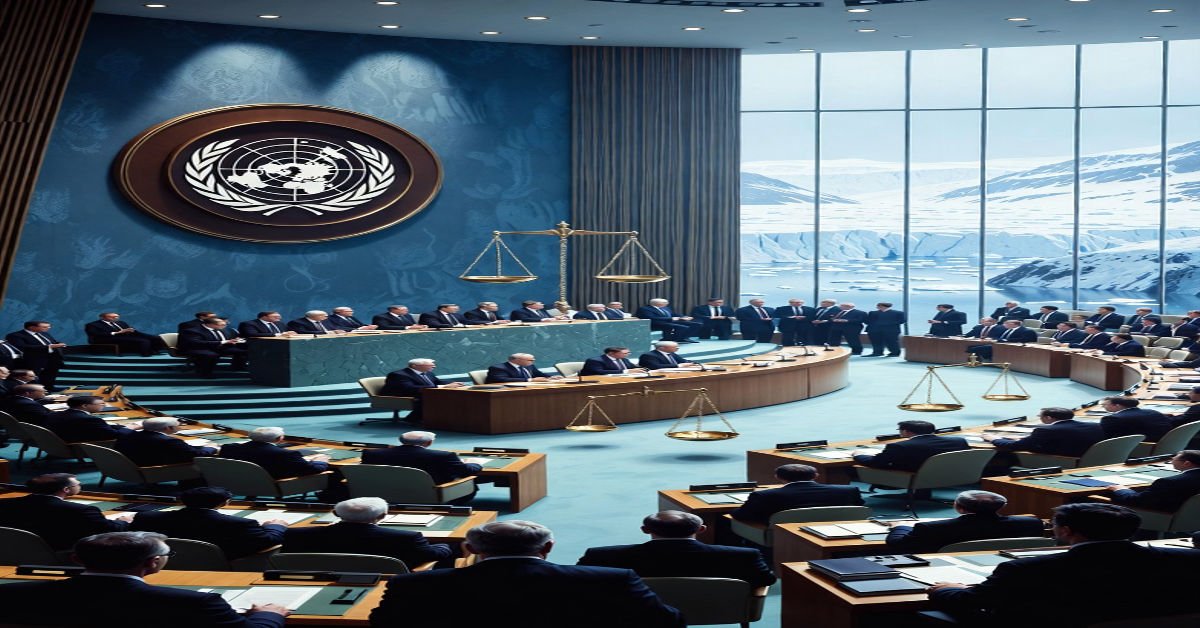
Greenland geopolitical crisis prominence in global geopolitics is no longer a distant strategic debate. It has become a deeply personal and political crisis for Denmark — one that forces uncomfortable questions about sovereignty, power, and moral consistency.
As renewed signals from the United States suggest a willingness to assert greater control over Greenland, Copenhagen has reacted with visible alarm. Danish troops have been reinforced on the island, and European allies have offered symbolic military support. Political rhetoric has shifted sharply toward the language of borders, international law, and self-determination.
What stands out, however, is not Denmark’s concern — but its surprise.
Why Greenland Has Always Mattered
Greenland’s strategic importance is neither new nor accidental. Its geographic position, access to rare minerals, control over Arctic routes, and military relevance have long made it a coveted asset in global power politics.
The resurgence of American interest is not a diplomatic misstep or rhetorical excess. It reflects a broader worldview where power, access, and security interests routinely override legal formalities. In that sense, Greenland is not an exception — it is a continuation.
For Denmark, this reality is unsettling because it turns the mirror inward.
Denmark’s Role in a Power-Driven World Order
For decades, Denmark has aligned closely with US-led security and military strategies. That alignment extended beyond diplomacy into direct participation in major conflicts framed as necessary for global stability.
These interventions were often justified using familiar language: protection of values, maintenance of international order, and collective security. Yet the long-term outcomes tell a different story.
Denmark’s Military Engagements and Outcomes
| Conflict Zone | Danish Role | Justification Given | Long-Term Outcome |
|---|---|---|---|
| Iraq | Combat participation | Security & alliances | Regional instability |
| Afghanistan | NATO military support | Counter-terrorism | Taliban return |
| Libya | Air strikes | Humanitarian protection | State collapse |
| Syria | Coalition involvement | Stability & democracy | Prolonged proxy war |
These interventions, while presented as principled, contributed to the erosion of the very international norms Denmark now invokes in defense of Greenland.
The Legal Principles Denmark Knows Well — and Has Bent Before
Denmark’s current argument rests on familiar ground: sovereignty is inviolable, territories are not bargaining chips, and international law must be respected.
Yet those principles were selectively applied in the past.
-
The invasion of Iraq proceeded without a clear legal mandate.
-
Afghanistan ended in exhaustion, not stability.
-
Libya’s intervention dismantled a state without a viable replacement.
-
Syria descended into chaos through prolonged external interference.
Each case weakened global trust in the rules-based order Denmark now seeks to defend.
Gaza and the Limits of Moral Clarity
Nowhere is this contradiction more visible than in Palestine.
As Gaza has suffered immense destruction, Denmark’s political response has been notably restrained. Despite warnings from international legal experts, humanitarian agencies, and UN bodies, calls for accountability have remained muted.
Meanwhile, Danish industry remains connected to global defense supply chains. A Danish defense firm continues supplying components for F-35 fighter jets — aircraft widely documented as central to recent military operations in Gaza.
When asked whether international arrest obligations would be enforced against Israeli Prime Minister Benjamin Netanyahu if he entered Denmark, the Danish prime minister declined to give a definitive answer.
The message is clear: law is conditional, and principles are flexible.
When Imperial Logic Comes Home
For years, the consequences of power-driven foreign policy unfolded far from Europe’s borders. Instability, displacement, and weakened institutions affected others — not the architects.
Greenland collapses that distance.
The same arguments once used to justify interventions abroad — strategic necessity, security concerns, global competition — are now being applied closer to Denmark’s own territory.
This is not injustice. It is exposure.
What Greenland Means for Europe
The Greenland moment carries wider implications for Europe as a whole:
-
Alignment with dominant powers does not guarantee protection
-
Loyalty does not ensure autonomy
-
International law cannot survive selective enforcement
A continent that tolerates the erosion of legal norms abroad should not be surprised when those norms fail at home.
Greenland’s rising geopolitical importance exposes Europe’s contradictions on sovereignty, international law, and great power politics.
Lessons for Europe From the Greenland Crisis
| Principle | Past Practice | Current Reality |
|---|---|---|
| Sovereignty | Selectively defended | Suddenly essential |
| International law | Applied inconsistently | Urgently invoked |
| Alliance loyalty | Prioritized over autonomy | Offers no guarantees |
A Reckoning, Not Just a Dispute
Greenland is not merely a territorial concern or a diplomatic standoff. It is a reckoning with decades of political choices that normalized power over principle.
The irony is complete. The question that remains is whether Denmark — and Europe more broadly — will finally learn from it.
Because international law cannot be sacred in the Arctic and disposable elsewhere. And principles abandoned abroad rarely remain intact at home.
1 thought on “Greenland Is More Than a Territory”