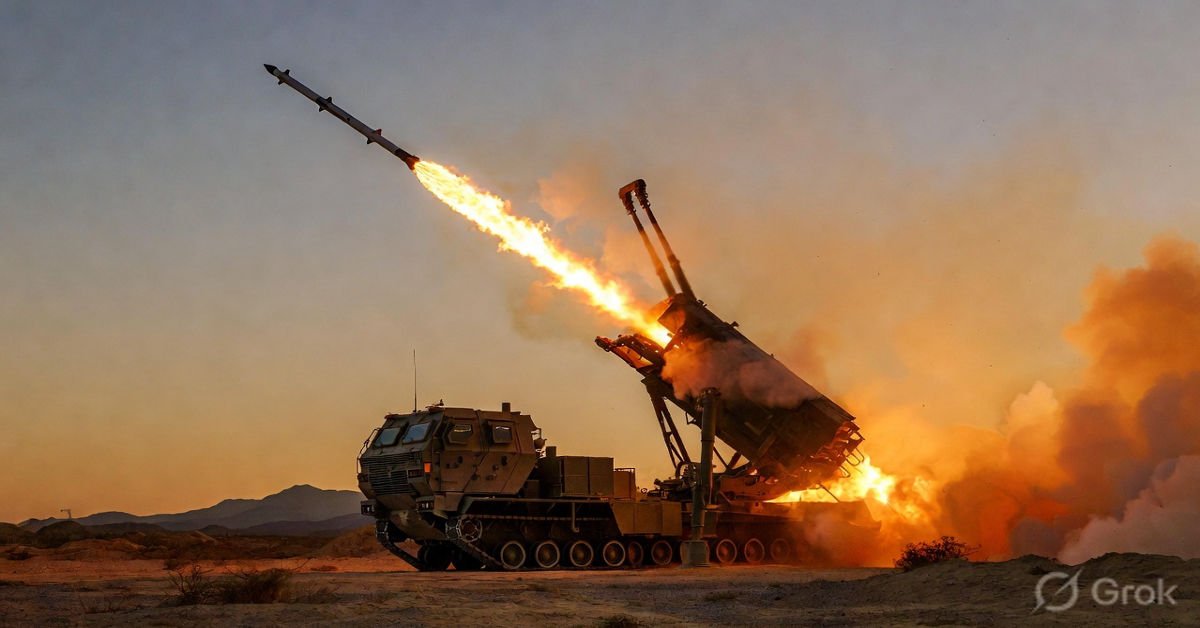
The Precision Strike Missile (PrSM) is one of the newest long-range weapons developed for the United States military. Recently, the missile drew global attention after the United States military reportedly used it for the first time during operations involving Iran, according to statements from the United States Central Command (CENTCOM).
CENTCOM confirmed that PrSM missiles were used during an operation named Operation Epic Fury, highlighting the missile’s advanced long-range strike capability. Military analysts consider this weapon an important upgrade to the US Army’s precision-strike systems.
In this article, we explain what the PrSM missile is, how it works, and why its first operational use is significant.
What Is the Precision Strike Missile (PrSM)?
The Precision Strike Missile (PrSM) is a next-generation surface-to-surface missile designed for long-range precision attacks. It was developed by the defense company Lockheed Martin for the United States Army.
The first batch of PrSM missiles was delivered to the US Army in December 2023, marking a major step forward in modern artillery and missile technology.
Key Characteristics of PrSM
| Feature | Details |
|---|---|
| Missile Type | Surface-to-Surface Precision Strike |
| Developer | Lockheed Martin |
| Range | 60 km to over 499 km |
| Launch Platforms | MLRS M270 and HIMARS |
| Payload | Insensitive Munitions explosive system |
| First Delivery | December 2023 |
The missile is designed to strike enemy targets with high accuracy over long distances, making it a critical asset in modern warfare.
Launch Systems Used for PrSM
PrSM missiles are compatible with two widely used artillery systems:
-
M270 Multiple Launch Rocket System
-
M142 HIMARS
Read more:Benzema Al Hilal transfer linked to Ronaldo
HIMARS System Overview
The M142 HIMARS (High Mobility Artillery Rocket System) is a mobile rocket launcher mounted on a wheeled vehicle, allowing it to move quickly across the battlefield.
| HIMARS Feature | Description |
|---|---|
| Mobility | Wheeled vehicle for fast deployment |
| Rocket Capacity | Up to six guided rockets |
| Missile Compatibility | ATACMS and PrSM |
| Reload Time | Around one minute |
| Crew Requirement | Small operating crew |
This mobility allows military forces to launch missiles and reposition quickly, reducing the risk of counter-attacks.
How PrSM Differs from ATACMS
The PrSM missile is designed to replace the older missile system known as Army Tactical Missile System (ATACMS).
| Comparison | ATACMS | PrSM |
|---|---|---|
| Maximum Range | About 300 km | Over 499 km |
| Missiles per HIMARS Pod | 1 | 2 |
| Technology | Older generation | Modular and upgradeable |
| Flexibility | Limited upgrades | Open systems architecture |
Because PrSM missiles are smaller and more advanced, launch systems like HIMARS can carry twice as many missiles per launcher pod.
Read more:Indian PM Modi Israel visit key takeaways
Strategic Importance of the PrSM Missile
The introduction of PrSM gives the United States greater long-range strike capabilities without needing new launch vehicles.
Military experts say the missile allows forces to:
-
Strike high-value targets at longer distances
-
Deploy missiles quickly using existing launch systems
-
Adapt technology using modular upgrades
-
Increase missile load without expanding equipment size
These capabilities are particularly important for modern military strategies involving rapid deployment and precision targeting.
Range Comparison With Other US Long-Range Weapons
The US military uses several long-range systems alongside PrSM missiles.
| Weapon System | Approximate Range |
|---|---|
| LUCAS One-Way Drone | ~800 km |
| ATACMS Missile | ~300 km |
| PrSM Missile | 499+ km |
| Tomahawk Cruise Missile | ~1,600 km |
Each system serves different roles depending on distance, cost, and mission requirements.
Read more:US Israel attack on Iran
Why the PrSM Missile Is Politically Significant
The development of longer-range missiles like PrSM also relates to international arms agreements. The Intermediate‑Range Nuclear Forces Treaty (INF Treaty) once restricted land-based missiles with ranges between 500 km and 5,500 km.
The treaty was originally signed in 1987 by:
-
Ronald Reagan, President of the United States
-
Mikhail Gorbachev, leader of the Soviet Union
However, the United States withdrew from the agreement in 2019, which allowed the country to resume development of certain missile systems that previously fell under treaty restrictions.
Why the First Combat Use Matters
Military analysts believe the first operational use of the PrSM missile marks a major milestone in modern artillery technology. It demonstrates how new precision weapons are being integrated into existing platforms such as HIMARS.
Key implications include:
-
Increased long-range strike capability
-
Greater battlefield flexibility
-
Enhanced precision targeting with reduced deployment time
As defense technology evolves, missiles like PrSM are expected to play an important role in future military operations.
Read more:Gas prices surge after QatarEnergy halts LNG production
Conclusion
The Precision Strike Missile (PrSM) represents a significant technological advancement in the United States military’s long-range strike capabilities. Developed by Lockheed Martin and integrated with systems like HIMARS, the missile offers greater range, improved flexibility, and higher missile capacity compared to previous systems.
Its reported first use in Operation Epic Fury highlights how modern warfare increasingly relies on precision weapons and adaptable military technology.