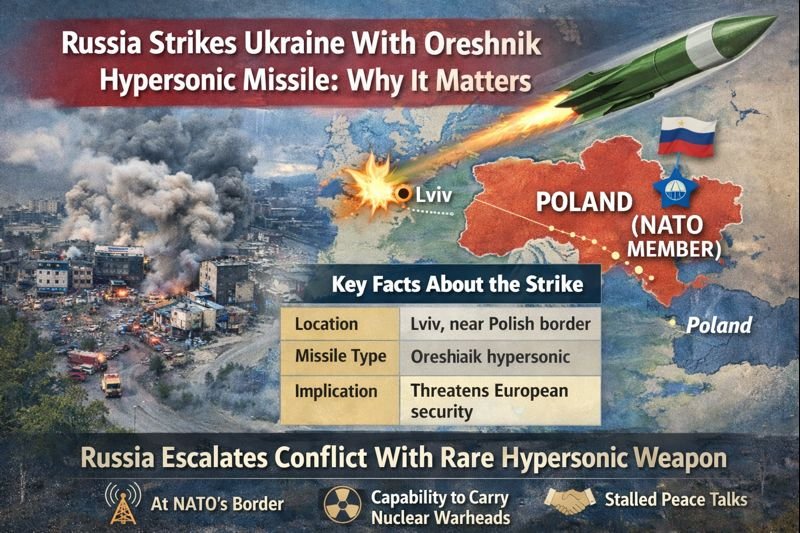
Use of rare hypersonic weapon near NATO border raises alarm as peace talks falter. Russia has confirmed that it launched its Oreshnik hypersonic missile in an overnight attack on Ukraine, striking near the country’s western border with Poland — a NATO member. The strike comes at a sensitive moment as diplomatic efforts to negotiate a ceasefire show little progress and the war approaches its fifth year.
Security analysts say the use of this advanced weapon was not only a military action but also a strategic signal aimed at Ukraine’s Western allies, particularly Europe and NATO.
What Happened in the Latest Attack?
According to Moscow, the strike was part of a broader wave of attacks targeting Ukrainian energy infrastructure and drone production facilities, particularly in and around Kyiv.
Russia claimed the assault was retaliation for an alleged Ukrainian drone attack on President Vladimir Putin’s residence in Novgorod in December 2025 — a claim strongly denied by Kyiv and dismissed by US President Donald Trump as unfounded.
Ukrainian authorities reported that:
-
Four people were killed
-
At least 22 were injured in Kyiv
-
Critical infrastructure was damaged in multiple regions
In western Ukraine, officials reported the use of a high-speed ballistic missile travelling at approximately 13,000 km/h, with investigations ongoing to confirm the exact weapon used.
Where Did the Oreshnik Missile Strike?
Russia stated that the Oreshnik missile was used in the strike near Lviv, a major city in western Ukraine.
Key Location Facts
| Location | Distance |
|---|---|
| Lviv to Kyiv | ~550 km |
| Lviv to Poland (NATO border) | ~70 km |
The proximity of the strike to Poland has significantly heightened concern among NATO members.
What Is the Oreshnik Hypersonic Missile?
The Oreshnik, named after the Russian word for “hazel tree,” is an intermediate-range ballistic missile capable of carrying multiple warheads. Its deployment is rare and highly symbolic.
Key Characteristics of the Oreshnik Missile
| Feature | Details |
|---|---|
| Type | Intermediate-range ballistic missile |
| Speed | Hypersonic (Mach 5+) |
| Estimated Range | 1,000–1,600 km |
| Warhead Capability | Conventional or nuclear |
| Interception | Extremely difficult |
Hypersonic missiles can change course mid-flight, making them far harder to intercept than conventional ballistic missiles.
Russia has previously stated that the missile’s destructive power rivals that of nuclear weapons, even when fitted with non-nuclear warheads.
Why Is This Strike Especially Significant?
This marks only the second known use of the Oreshnik missile, following a test strike in November 2024 on eastern Ukraine. That earlier attack reportedly used dummy warheads, resulting in limited damage.
If confirmed that explosive warheads were used this time, it would represent the first full operational deployment of the Oreshnik against Ukraine.
Why This Attack Stands Out
-
First strike near a NATO border
-
Possible first combat use with live warheads
-
Occurred amid stalled peace negotiations
Ukrainian Foreign Minister Andrii Sybiha described the attack as a “grave threat to European security”, calling for a strong international response.
European leaders echoed those concerns. The governments of the UK, France, and Germany jointly condemned the strike as “escalatory and unacceptable.”
Military Message to the West?
Experts believe the strike was designed less for battlefield impact and more as a message to Western governments.
“Russia could have achieved similar military effects without using this missile,” said Cyrille Bret of the Montaigne Institute. “The choice of weapon is about communication with the West.”
The missile’s deployment close to NATO territory appears aimed at testing Western resolve without directly triggering collective defence obligations.
Why Does This Matter Now?
The attack comes as diplomatic efforts to end the war remain stalled. Core disagreements — particularly over territory — continue to block progress.
Ukraine has firmly rejected proposals that would require it to surrender occupied or controlled land, including elements of Donald Trump’s 28-point peace plan unveiled in late 2025.
Analyst Perspectives
| Expert | Assessment |
|---|---|
| Marina Miron (King’s College London) | Peace talks already stalled; escalation unlikely to change trajectory |
| Mikhail Alexseev (San Diego State University) | Russia using talks as cover to continue war |
Analysts broadly agree that the missile strike is unlikely to derail talks that were already struggling, but it raises the risk of further escalation, especially involving Europe.
A Wider Security Concern for Europe
The strike also follows Russia’s decision to deploy Oreshnik missile systems in Belarus in December 2025, expanding Moscow’s ability to target European territory in a future conflict.
With NATO borders now directly in range, the use of such weapons adds a new layer of uncertainty to an already volatile war.
Conclusion: A Dangerous Signal in a Stalled War
Russia’s use of the Oreshnik hypersonic missile near NATO territory marks a significant escalation in symbolism, if not immediate military impact. While it may not alter the battlefield overnight, it sends a clear warning to Europe and the transatlantic alliance.
As peace efforts remain frozen and advanced weapons enter the conflict, the risk of miscalculation continues to grow — with consequences that could extend far beyond Ukraine.
1 thought on “Russia Strikes Ukraine With Oreshnik Hypersonic Missile: Why the Attack Matters”