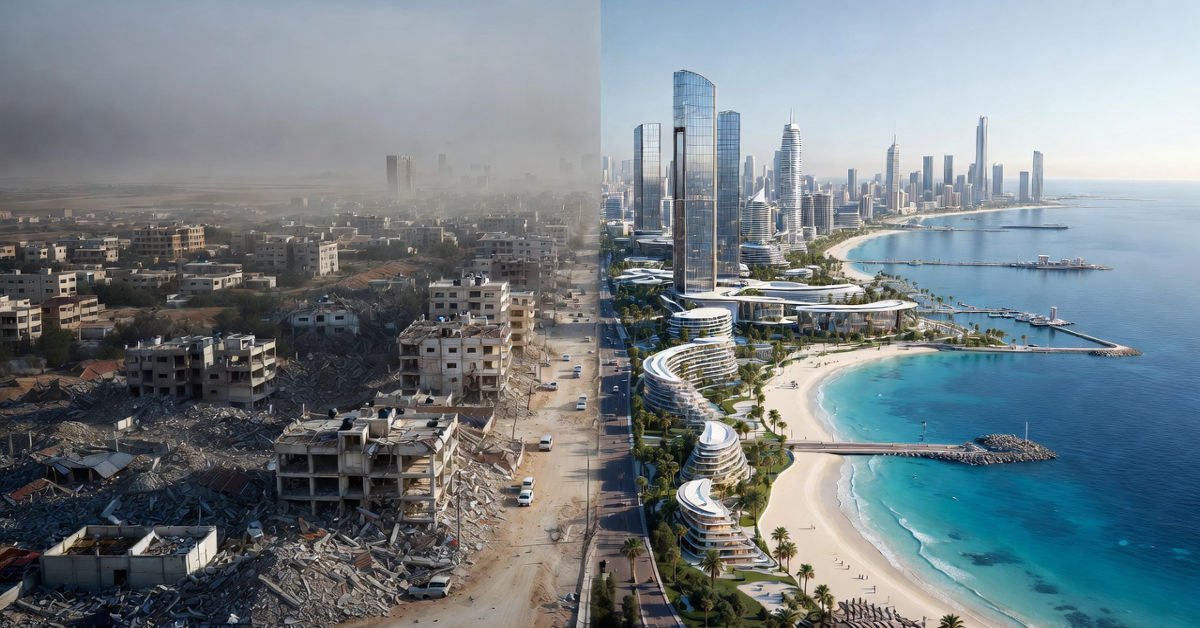
A sweeping reconstruction vision promises prosperity and skyscrapers—but excludes the people of Gaza
At the World Economic Forum in Davos, Switzerland, a bold and highly controversial vision for post-war Gaza was unveiled by Jared Kushner, real estate developer and son-in-law of former US President Donald Trump. Framed as a comprehensive reconstruction blueprint, the plan promises tourism hubs, industrial zones, airports, ports, and hundreds of thousands of jobs.
But critics say the proposal reflects an imperial-style redevelopment agenda—designed without consulting Palestinians and disconnected from Gaza’s devastating humanitarian reality.
“There is no Plan B,” Kushner declared during his presentation, underscoring the administration’s confidence in a project that has already sparked intense global debate.
Gaza After the War: Destruction on an Unprecedented Scale
Since October 7, 2023, Gaza has endured one of the most destructive military campaigns in modern history. Israeli bombardment, launched after Hamas-led attacks in southern Israel, has killed more than 71,000 Palestinians, with thousands more missing and presumed buried under rubble. Even after a US-brokered ceasefire announced in October 2025, hundreds more Palestinians have been killed in subsequent strikes.
More than 80 percent of Gaza’s infrastructure—including homes, hospitals, universities, water networks, and electricity systems—has been destroyed or damaged. Nearly 2.3 million residents have been displaced, many repeatedly, while food, water, and medical aid remain severely restricted.
Against this backdrop, Trump’s redevelopment proposal has raised profound ethical, legal, and political questions.
A Vision of ‘New Gaza’—Without Gazans?
Trump described the Gaza coastline as “prime real estate,” highlighting its Mediterranean location and commercial potential.
“I’m a real estate person at heart,” Trump told the Davos audience. “Look at this beautiful piece of property—what it could be for so many people.”
However, core issues such as land ownership, property rights, accountability for war crimes, and Palestinian self-determination are absent from the proposal. The plan envisions luxury developments rising atop an estimated 68 million tonnes of war debris, where thousands of bodies remain unrecovered.
Human rights experts argue that rebuilding without addressing justice and consent risks entrenching displacement rather than ending it.
What Is Trump’s ‘Board of Peace’?
A new global body—or a rival to the United Nations?
At Davos, Trump formally announced the creation of a “Board of Peace”, positioned as the authority overseeing Gaza’s reconstruction and future governance.
Key details of the Board of Peace
| Feature | Details |
|---|---|
| Membership term | 3 years |
| Cost of permanent seat | $1 billion |
| Chairman | Donald Trump (with veto power) |
| Executive members | Jared Kushner, Tony Blair, Marco Rubio |
| Notable inclusion | Israeli PM Benjamin Netanyahu |
| Charter length | 11 pages |
| Mentions of Gaza | None |
Despite being framed as a Gaza-focused body, the board’s charter does not explicitly mention Gaza, instead suggesting a broader ambition to mediate international disputes—raising concerns it could act as a parallel structure to existing global institutions.
Several countries, including China and Russia, reportedly received invitations. Canada’s invitation was later withdrawn following diplomatic tensions.
What’s Actually in the Gaza Redevelopment Plan?
Kushner outlined an ambitious economic transformation aimed at turning Gaza into a regional hub for trade, tourism, and technology.
Economic targets outlined in the proposal
| Metric | Projection |
|---|---|
| GDP by 2035 | $10 billion |
| Current GDP (2024) | $362 million |
| New jobs | 500,000+ |
| Total investment | $25 billion |
| Vocational training | $1.5 billion |
Funding sources were not disclosed, and no international donor commitments were confirmed.
Four Phases of Development Across Gaza
The plan divides Gaza’s reconstruction into four sequential phases, beginning in the south and moving north.
| Phase | Area Covered |
|---|---|
| Phase 1 | Rafah and parts of Khan Younis |
| Phase 2 | Remaining Khan Younis |
| Phase 3 | Central Gaza refugee camps |
| Phase 4 | Gaza City (north) |
Kushner claimed each phase would take two to three years, yet offered no explanation for where displaced residents would live during construction or how housing allocations would be determined.
Coastal Tourism, Skyscrapers, and Ports
One of the most striking elements of the plan is its focus on coastal tourism. Nearly the entire Mediterranean shoreline is designated for high-end development.
Key features include:
-
Up to 180 skyscrapers
-
A new commercial port near the Egypt border
-
A proposed international airport
-
Free-trade and logistics zones
Critics warn that such zoning could privatize Gaza’s coastline, limiting public access and marginalizing existing communities.
Employment Promises vs Economic Reality
According to Palestinian statistics, Gaza’s unemployment surged by 80 percent during the war, leaving more than 550,000 people jobless. GDP per capita collapsed to just $161 per year, among the lowest globally.
While Kushner’s plan promises mass employment in construction, agriculture, manufacturing, and services, Palestinian civil society groups say no local actors were consulted.
“We were completely surprised,” said Amjad Shawa, director of the Palestinian NGOs Network in Gaza. “No one asked us about Gaza’s future.”
‘New Rafah’ and ‘New Gaza’: A Digital Future?
Kushner showcased AI-generated images of futuristic urban centers labeled “New Rafah” and “New Gaza.”
Planned infrastructure includes:
-
Over 100,000 housing units
-
200 schools
-
75 medical facilities
-
Data centers and digital hubs
Yet critics argue these visuals mask unresolved realities—such as ownership rights, displacement, and political sovereignty.
Demilitarisation: A Precondition for Reconstruction
Kushner made clear that rebuilding would only begin after:
-
Full disarmament of Hamas
-
Withdrawal of Israeli forces
-
Formation of a technocratic Palestinian governing body (NCAG)
Under the plan:
-
Hamas’s heavy weapons would be immediately decommissioned
-
Smaller arms phased out by a new Palestinian police force
-
Some Hamas members could receive amnesty or reintegration after vetting
Hamas has rejected the proposal, warning it would eliminate Gaza’s ability to defend itself.
A Vision Without Consent?
Palestinian-American author Susan Abulhawa described the proposal as an attempt to erase Gaza’s identity and reduce its people to a low-cost labor force.
Despite its grand scale, the plan offers no pathway to Palestinian statehood, no accountability for wartime destruction, and no assurance that Gazans themselves will shape their future.
2 thoughts on “Trump Gaza development plan”