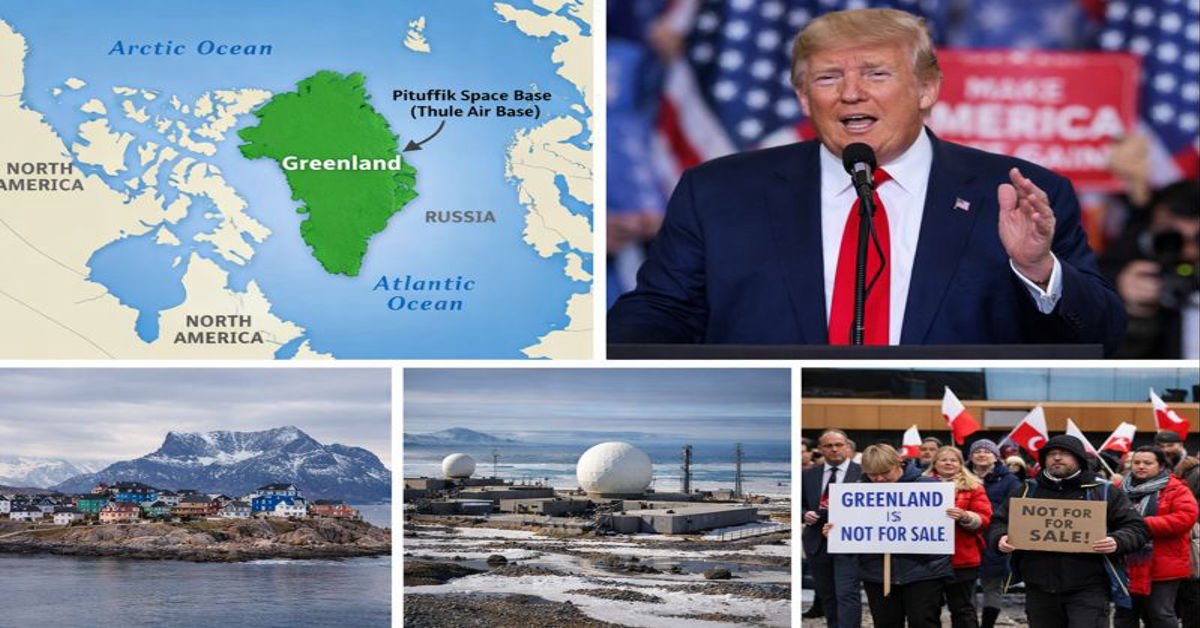
The European Union has called an emergency meeting after former US President Donald Trump unveiled a sweeping tariff plan targeting European allies in connection with his renewed push to acquire Greenland. The move has sparked diplomatic tension across NATO partners and raised concerns about economic retaliation and geopolitical stability in the Arctic.
Trump’s announcement revives a long-standing and controversial American interest in Greenland — but his latest tactic, tying trade penalties to territorial ambitions, has drawn unusually strong resistance from Europe.
What Exactly Did Trump Threaten?
Trump declared on his Truth Social platform that several European nations would face escalating tariffs unless Denmark agreed to negotiate the sale of Greenland to the United States.
He argued that the US has long “subsidised” European allies through favorable trade terms and claimed Greenland is essential for global security.
Proposed Tariff Timeline
| Date | Countries Affected | Tariff Rate |
|---|---|---|
| February 1 | Denmark, Norway, Sweden, France, Germany, UK, Netherlands, Finland | 10% |
| June 1 | Same countries | 25% |
| Duration | Until Greenland purchase agreement | Indefinite |
Trump framed the issue as a national security priority, citing rising Arctic activity by China and Russia.
Why Greenland Matters Strategically
Greenland is geographically located between North America and Europe and occupies a key position in Arctic defense infrastructure.
Strategic Importance
| Factor | Significance |
|---|---|
| Military Position | Controls air/sea routes between continents |
| Early Warning Systems | Vital for missile detection coverage |
| NATO Presence | Hosts Pituffik Space Base (US military) |
| Arctic Access | Gateway to emerging polar trade routes |
The island’s vast mineral deposits — including rare earth elements critical for advanced technology and renewable energy systems — add another layer of geopolitical value.
However, Greenland’s population of roughly 56,000, primarily Inuit, has repeatedly opposed external control and large-scale extraction projects.
Historical US Attempts to Buy Greenland
Trump is not the first US leader to consider acquiring Greenland.
| Year | US Leader | Outcome |
|---|---|---|
| 1867 | William H. Seward | Proposal rejected |
| WWII | US Military Occupation | Temporary control after Denmark fell to Germany |
| 1946 | President Truman | Offered $100M — Denmark refused |
| 2019 | Trump (first term) | Denmark called proposal “absurd” |
Despite these repeated efforts, Denmark and Greenland have consistently maintained that the territory is not for sale.
Public Opinion in the United States
Recent polling suggests Americans largely reject the idea of purchasing Greenland.
| Poll | Support for Acquisition |
|---|---|
| Reuters/Ipsos (Latest) | Less than 20% |
This indicates Trump’s position is not aligned with mainstream US voters.
Europe’s Unified Response
European leaders reacted swiftly and firmly.
Key Reactions
| Leader | Country/Institution | Statement Summary |
|---|---|---|
| Keir Starmer | United Kingdom | Greenland’s future belongs to Denmark & Greenlanders |
| Ursula von der Leyen | European Commission | Tariffs threaten transatlantic stability |
| Antonio Costa | European Council | Expressed full solidarity with Denmark |
| Kaja Kallas | EU Foreign Policy | Warned divisions benefit Russia & China |
| David van Weel | Netherlands | Called move “blackmail” |
The tone from Europe signals rare unity and frustration toward Washington over using trade as leverage for territorial goals.
EU Considers Trade Countermeasures
France has urged the EU to activate its Anti-Coercion Instrument (ACI), a legal mechanism designed to deter economic intimidation.
What the Trade Bazooka Allows
| Measure | Possible Impact on US |
|---|---|
| Retaliatory tariffs | Increased costs for US exporters |
| Market restrictions | Limits on US firms operating in EU |
| Financial controls | Higher funding barriers for US banks |
| Procurement bans | Exclusion from EU government contracts |
The ACI was originally designed to counter pressure from authoritarian states, making its potential use against the US particularly striking.
Greenland’s Position
Greenlandic leaders and citizens have strongly rejected Trump’s renewed interest. Protests have taken place in Nuuk, emphasizing sovereignty and Indigenous rights.
Local authorities reaffirmed that Greenland’s political future will be determined only through democratic self-governance within the Kingdom of Denmark.
Geopolitical Risks
Experts warn Trump’s tariff strategy could trigger:
-
Trade conflict between NATO allies
-
Greater Russian and Chinese influence in Arctic diplomacy
-
Economic instability across transatlantic markets
-
Political backlash within Greenland
The Arctic has become one of the world’s fastest-emerging strategic frontiers, and escalating tensions could reshape power dynamics there.
Conclusion
Trump’s tariff announcement has transformed a dormant territorial idea into an active diplomatic flashpoint. While Greenland remains strategically important, Europe’s united opposition signals that economic pressure will not alter sovereignty decisions.
The coming weeks will determine whether this dispute becomes a short-lived political gambit or evolves into a deeper transatlantic confrontation.
2 thoughts on “Trump tariffs over Greenland”