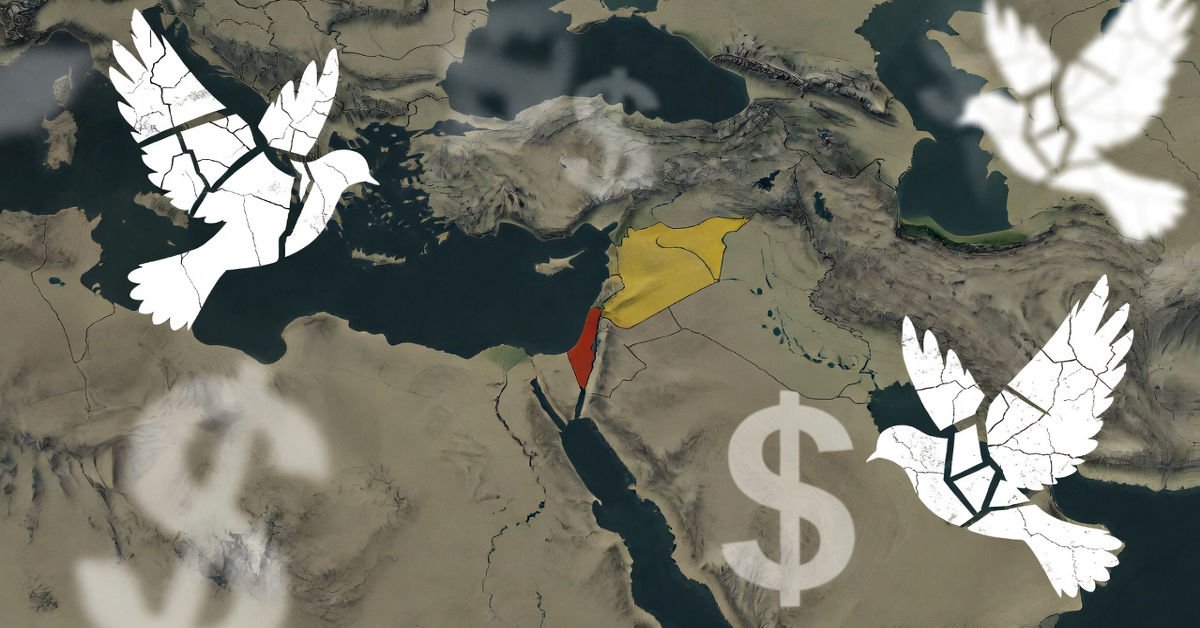
Why neoliberalism can’t build peace: Over the past few decades, economic growth has often been presented as a shortcut to peace. Many Western policymakers argue that investment, jobs, and market integration can calm political tensions and resolve long-running conflicts. However, experience shows that this approach rarely delivers lasting stability.
Recent global conflicts demonstrate a recurring pattern: economic incentives are offered without resolving the underlying political and national grievances of affected communities. This disconnect explains why neoliberal peace strategies continue to fall short.
The Economic Logic Behind Modern Peace Proposals
During his presidency, Donald Trump promoted a business-style approach to diplomacy. His administration frequently framed peace initiatives around economic rewards, trade opportunities, and investment plans in regions affected by conflict, including Gaza, eastern Ukraine, and the Golan Heights.
While this strategy was marketed as innovative, it followed a long-standing neoliberal belief: economic development alone can neutralize political conflict. History suggests otherwise.
Lessons from Occupied Palestine
The Idea of “Economic Peace”
In the early 1990s, former Israeli Foreign Minister Shimon Peres promoted the idea of “economic peace” as part of the Middle East peace process. His vision imagined Israel as a regional economic hub, linked to neighboring Arab economies through shared infrastructure and markets.
Palestinians were promised improved living standards, employment opportunities, and foreign investment in exchange for political stability.
What Happened Instead?
Rather than ending instability, this model unfolded alongside expanding occupation and increasing restrictions. Economic growth remained uneven and fragile, and public frustration intensified, eventually contributing to renewed unrest in the early 2000s.
Economic Reality in the Palestinian Territories
| Indicator | Outcome |
|---|---|
| GDP trend | Significant decline over several years |
| Poverty rate | More than half the population affected |
| Employment | Heavily dependent on external controls |
| Investment | Limited and politically constrained |
The “Quick Impact” Model and Its Limits
In 2007, the international Quartet—led by the United Nations, European Union, the US, and Russia—appointed Tony Blair as envoy.
His strategy focused on short-term economic projects designed to boost confidence and attract donor funding. At the same time, Palestinian governance reforms emphasized fiscal discipline and security coordination.
Even the World Bank cautioned that economic growth without political sovereignty would not be sustainable.
Who Benefited?
| Group | Impact |
|---|---|
| Political elites | Increased access to funding |
| Security institutions | Expanded resources |
| General population | Minimal long-term improvement |
This model replaced political self-determination with economic management, leaving core issues unresolved.
Gaza and Investment-Led Peace Plans
More recently, Jared Kushner introduced an economic framework for Gaza that emphasized private investment and regional business partnerships.
While the proposal highlighted potential economic gains, it largely sidestepped questions of political rights, governance, and long-term security guarantees. Economic opportunity was framed as a substitute for addressing national aspirations.
Extending the Same Model Elsewhere
Golan Heights
In the Golan Heights, proposals have included transforming contested territory into shared economic zones under external security guarantees. Critics argue that such plans prioritize strategic interests over international law and local consent.
Donbas Region of Ukraine
In eastern Ukraine, similar thinking has emerged around creating special economic zones in the Donbas. These proposals risk weakening national sovereignty while offering no firm protection against renewed conflict.
| Region | Proposed Solution | Key Risk |
|---|---|---|
| Gaza | Investment-led development | No political guarantees |
| Golan Heights | Joint economic zones | Sovereignty concerns |
| Donbas | Free economic zone | Loss of strategic control |
Why Neoliberal Peace Strategies Fail
The central flaw is simple: markets cannot replace political solutions. Investors require stability, legal clarity, and credible guarantees—conditions that cannot exist without resolving questions of sovereignty, rights, and representation.
Communities affected by conflict are not just labor pools or consumers. They are societies with shared histories, identities, and political aspirations.
A Sustainable Path to Peace
Economic development can support peace—but only after political agreements are in place.
What Effective Peacebuilding Requires
-
Recognition of collective and national rights
-
Adherence to international law
-
Credible political settlements
-
Economic growth that follows, not replaces, justice
When economic incentives are used to bypass political realities, peace remains fragile and temporary. Lasting stability emerges only when political dignity and self-determination come first.
Final Thought
Neoliberal frameworks promise efficiency and growth, but peace cannot be engineered like a business deal. Without addressing the root causes of conflict, economic solutions alone will continue to fall short—no matter where they are applied.